File Syncing Is Blending Your Work Life and Your Personal Life

This blog post I wrote ran on Harvard Business Review today.

File syncing is evolving into the mainstream, with the adoption rate of services such as file access, sync, and share growing from 9% in 2010 to 15% in 2012. Gartner is predicting that one-third of consumers’ digital content will be “in the cloud” by 2016. What’s more, file syncing is moving beyond the consumer space and into the business environment — almost two-thirds of the devices used by information workers are now portable, and more and more people are sharing files and information across multiple devices (smartphones, tablets, PCs, etc.) in their daily work activities. Fifty-two percent of information workers now use at least three devices for business, and 34% use four or more. We’ve seen this new wave of technology coming, and now its usage is being validated.

howoften.jpg

As a result, more and more people are combining their “personal” and “business” clouds for greater efficiency and productivity. Workers say they mix work and personal use on 60% of their devices. Earlier this year, Entrepreneur magazine said: “The idea of having a ‘personal cloud’ for storage is so 2011. Now you can combine office, mobile, web-based and even home-based storage options to achieve near-automatic caching of data on everything from your smartphone to your TV set-top box. What’s more, the line has become blurred in terms of personal and business use of such technologies.” According to the Forrester report, 47% of all cloud users are storing both personal and work data. While photos and personal documents remain among the top items stored in the cloud, other media and work documents have grown by nearly 30% in the past couple of years.

With all the data in our lives intermingling in the cloud, we need to be conscious of how we want it to function, and we need to be smart about how we organize it. Many of us enjoy the convenience of accessing multiple sets of data (personal and business) from a single cloud. But what about those who like to keep more discreet lines between their personal and professional lives? Both companies and individuals need to think through the scenarios of access, permissions and backup. For instance, what happens if you change jobs? It’s important to clarify who has access to which data. What is the company policy on having personal data on a work device and vice versa? A great way to manage in this situation is to put all of your data — both personal and business — in the cloud so you have easy access and so that it’s backed up, but you only sync local to the device that’s appropriate. When choosing a cloud solution, users should be sure to verify that this is possible.

datastorage.jpg

I believe we’re only seeing the beginning of file syncing adoption and its value. (Full disclosure: I’m the CEO of a cloud computing company, which gives me a good deal of perspective — and also makes me somewhat biased.) Indeed, what’s the point of having all of these powerful smartphones and tablets if we can’t access our digital files anywhere, at any time? What does it mean for our personal and business lives, and where is this growing trend leading us? Here’s what I see from my vantage point: With people storing more of their information in the cloud, both hardware and software companies will need to continue developing “out of the box” solutions for both personal and business use (including ways to keep the two accessible, but separate), which will make it easier than ever to access, manage, and sync content. File syncing will need to remain affordable, while reducing the need to purchase bigger, more expensive hard drives. Cloud services companies will most likely continue to offer a limited amount of storage free, with larger or group plans priced economically. As a result, I think we’ll also see more IT organizations support the integration of personal and business cloud services for their employees.

This “infrastructure” is supporting a true cultural shift with business and personal data blending in the cloud, and HR policies will need to follow suit. Organizations will need to accept the fact that employees will interact with their “personal” data — such as Twitter and Facebook posts and LinkedIn connections — while at work, and rather than viewing this as a distraction, they should recognize that it is a “whole person” who shows up for work, and that being able to access personal information and networks while on the job actually makes for more productive employees. And certainly there is a bit of tit-for-tat given that employees are frequently working beyond the traditional work day.

As the lines between business and personal lives are shifting, the cloud has emerged as a key tool to keep people productive and organized. The ‘personal cloud’ is evolving to an ‘all-purpose cloud’ that helps us manage our entire lives. “Getting in sync” will soon become an everyday life action and expression, with a technical meaning that everyone understands and automatically uses.
Systems Thinking

I recently read an article titled “Cowboys and Pit Crews” by one of my favorite writers, Atul Gawande.  I was turned on to Gawande’s writing, specifically the books Better and Complications by son Derek.  He is in his fourth year of medical school and apparently they assign some of his writing to the students.  Gawande writes insightfully particularly around policy and process issues in medicine with the objective of improving the overall system – training, practice, etc.

The main point of the article is that medicine has evolved from a field where individual doctors “could hold all the key information patients needed in their heads and manage everything required themselves” to one where clearly that’s not possible.  Anyone who has experienced even something as common as a torn ACL can think about the number of people who take care of them from internist, radiologist and orthopedic surgeons to the MRI tech, nurses and physical therapists – easily more than a dozen.

Success then results as much (or more) from the system working properly as from the individual e.g. the surgeon performing well.  The places that have the best results for, say cataract surgery or ACL replacement are well run systems that, of course, have competent surgeon members. Having grown up in a family of physicians (both parents, 2 siblings, many cousins etc.) suddenly what they do seemed to more and more like what I and members of my team here at SugarSync do.

In managing a system, the first thing you need to do is know your goals and measurement criteria then set up measurement systems to know if you are meeting those goals.  Our VP of Engineering Brock LaPorte popped into my head as I thought about systems engineering as this is his primary mode of operation.  Sure – he can solve individual technical problems but his main contribution is making sure the systems – hardware, software and people, function well.    That always starts with instrumentation – without that data you can’t improve the system.    This is part of the engineering discipline both academically and in practice.  As I’ve chatted with my two sons in medical school – this is notably absent in their training.  It might be part of advanced degree programs in public health but not medicine itself.

Any experienced, successful manager of a major internet service builds in instrumentation capabilities from the start.  They needn’t be expensive – at SugarSync most of our measurement tools are open source – built and contributed over the years by practitioners.    As much as possible is captured in the logs – even data that may not be analyzed at the time – for future use.  With the digitization of health care records – more data should be available for measurement and analysis to allow us to have better functioning systems.  Hopefully medical educators will include these key skills into the training.  I believe there is an opportunity for more cross-pollination with industries such as internet services that do this well.  The stakes are high both in terms of health and dollars.

Familiarity Breeds Empathy

Like many others, I’ve been glued to the news following the conflict in the Middle East.  After working for an Israeli company for 4 years I have many friends in Tel Aviv plus family in Jerusalem.  I fear for their safety and mourn the bloodshed that has occurred.  I feel very angry about the rocket fire against Israel that occurred prior to this current escalation.  That fear turned anger continued as I even found myself thinking it’s the “fault” of those in Gaza for “starting” the violence.  But that limbic emotional cycle was interrupted.

In the midst of watching the news I was checking my Facebook page and saw updates from two of our Palestinian TechWomen Alumnae.  They are currently in Gaza, without power and are not far where the bombs have struck.  Gaza is relatively a small geographic area so their proximity to violence is not surprising.  Their anguish was apparent in the posting and just as I can picture my Israeli cousin Lexi trying to entertain 3 children under 5 in a bomb shelter I can similarly picture Hwayda and Lama, afraid, in the dark with the sound of bombs nearby.   Rola who interned with me here at SugarSync is from the West Bank originally.  Though most of her family is now in Amman she still has family both in Gaza and in the West Bank and I’m sure they are anguishing over their safety.

Suddenly my feelings of anger changed.  Rola, Hwayda and Lama are brilliant kind women who I came to respect during their time here.  This is a human tragedy on both sides and both sides of this conflict deserve empathy and security.  Rola and I ventured to talk a bit of politics when she was here.  It was difficult and we disagreed on several topics but it was good to hear the other side and associate it with a human being who I respect.  It is hard to maintain hate when you are reminded of friendship.

As you get to know people personally you are reminded of their humanity and hence, how we are more similar than different.   A political or religious difference is smaller than the shared experience of family and community.  Familiarity does indeed breed empathy.

I believe that familiarity leading to empathy is the fundamental basis of the success of the gay rights movement in the last 40 years.  The willingness of gays to be open about their orientation has been the key.  As people realized that gays and lesbians are their friends, family, and coworkers whom they loved and respected many of the stigmas began to go away.  I’m not saying that discrimination based on sexual orientation does not exist – it does – but the pace of change and improvement is unprecedented.

Unfortunately, for what I believe is the same reason in converse , we have not seen similar change regarding choice.  The percentage of those who are anti-choice has remained constant or even gone up in the last 39 years since Roe v. Wade.  I don’t think religion is the difference from the reduction in homophobia as there are religious dictates against both homosexuality and abortion – I think it is the private nature of abortions.  For completely understandable reasons, our friends, coworkers and even family members have kept their abortions private and they will likely never come out of the closet.  I believe this is appropriate but it means less social and political impact.  We will need to find other ways to build empathy for those in this situation.

More than ever before we need a bigger dose of empathy in our society.  Either to build bridges across political parties so that our government can function, to step away from violence and war in the Middle East and even just to be kind to all of our neighbors.  This is a change I would really be thankful for.

Milestones and Goals

Yesterday we hit a major milestone at SugarSync.  After almost a year of work we shipped the beta version of SugarSync 2.0.  This version represents a complete redesign of the SugarSync app from the ground up.  For more details on the new version you can read Drew Garcia’s blog post or check out the beta page on the website. SugarSync has always been recognized as having the most powerful and flexible product but we needed to make it easier to use.  Our goal was to make the power of the cloud more accessible to non-technical users and I think we’ve done a good job with that.  Early reviews from tech journalists have been very positive and, most importantly, I look forward to hearing from our users.

Particularly when teams work so hard for a long time on a goal and then accomplish it, it is really important to recognize that accomplishment.  We had a small lunch party at the office yesterday and Friday afternoon will take the team offsite for a real celebration.  It seemed prudent to be in the office “day of” in case of issues and it will be fun to let off steam and celebrate on Friday.  We sent a roundup of the reviews to our investors who of course were happy to see the positive feedback – after all this was a big financial as well as human investment.  I was on the phone with one of the board members yesterday on another topic and he commented, “nice reviews, how are the numbers?”  This reminded me of a great post “The Work Begins when the Milestone Ends”.

After all, the SugarSync 2.0 release is the milestone not the goal.  The goal is happy users and the ultimate goal is to build from those users a growing, sustainable business.  Fortunately, and not by accident, the team understands this as well.  We’ve instrumented the app to understand usage and encourage feedback.  The first wrap-up email from our director of product management to the team at the end of the day was about the feedback and what we should do with that feedback and how to get more feedback and then channel that back into product improvements.

This need to recognize the difference between the milestone and the goal is important in our personal lives as well.   As parents we so often focus on grades as the goal but, I believe, they are the milestone.  Education to enable life skills and character are the goal.  Of course, milestones serve a purpose – there is little chance of meeting the goal without meeting a reasonable percentage of the milestones but both effective parenting and effective business leadership require recognition of which is which and striking the right balance of focus.

Why Diversity

There have been several great studies and related articles recently about the improved business results that come from diversity.  According to Credit Suisse Research Institute, over the past six years, companies with at least some female board representation outperformed those with no women on the board in terms of share price performance.  According to a recent study by Dow Jones Venture Source having, a higher proportion of female executives at a venture-backed start-up improves the company’s chances for success.  Specifically:

  • “In comparing successful versus unsuccessful companies, the overall median proportion of female executives is 7.1% and 3.1%, respectively, demonstrating the value that having more females can potentially bring to a management team.
  • We also see that a company’s odds for success (versus unsuccess) increase with more female executives at the VP and director levels.”

The study, based on a very large database of companies (n=20,194) contains a wealth of other interesting data, in particular the fact that companies grow their percentage of female executives over time.  I encourage those with an interest in this topic to read the entire study.

So this is great news and hopefully the publicity about this news will cause people to examine their companies, investments and open more doors.  I’ve always assumed that diversity led to improved results and am thrilled to see such compelling data.  The question still remains though as to why.  I can think of three possible explanations.

My first thought is that perhaps the dramatic absence of diversity at the unsuccessful companies reflects a management team and board that is almost by definition (complete absence of women when there is available talent) horribly biased and closed minded.  This parochialism then impairs their business judgement leading to poorer outcomes.

Another theory assumes significant bias for women during their careers and that those who make it to the executive ranks are higher performing than their peers.  This reminds me of the time (December 1987) our family took a vacation in Israel and Egypt.  One of the highlights was the sightseeing we did in Cairo before heading south for a Nile river cruise.  Before we left a friend gave me a tip to ask for a female tour guide.  She explained to me that competition for the government licensed tour guide positions and discrimination against women was so fierce that any woman who managed to get a position would be particularly well qualified.

Both of these theories don’t ring true to me.  I’m sure the first one exists (hopefully not in large quantity) but there could be other explanations for the absence of women.  Regarding the second idea – it is not clear to me that the biases against women are so strong before the executive level that this would lead to such a positive selection bias.

I believe the truth must lie somewhere in the dynamics of the diverse team itself.  I started researching this topic and came across this Cornell study. Why Differences Make a Difference: A Field Study of Diversity, Conflict, and  Performance in Workgroups.  First off it is interesting the lack of recent studies – this one dates from the 90’s.  I found this study and several of those that predated and led to it to be fascinating.  They break down diversity into 3 components,  informational diversity, social category diversity and value diversity.

Not surprisingly, informational diversity (diversity of, for instance, functional, job and practical experiences) is positively correlated with performance.  Value diversity, due to heightened conflict is negatively correlated with performance.  Social category (e.g. age, gender, race) diversity was less clear.  Counter-intuitively their study showed positive correlation between morale and social category diversity.  Perhaps social category diversity itself is positively correlated with informational diversity which leads to improved performance.

I believe strongly in the benefits of informational and social category diversity.  Avoiding hiring a large percentage of team members from a particular company (though it is a natural tendency) is critical.  I believe that social category diversity helps insure some extra informational diversity plus make day-to-day life in the company more socially interesting.  It is not easy to achieve this – in fact it likely takes extra effort by the stakeholders, particularly to achieve this while ensuring similarity of values and goals, but the results are clearly worth it both in terms of the results and enjoyment along the way.

TechWomen in Washington DC

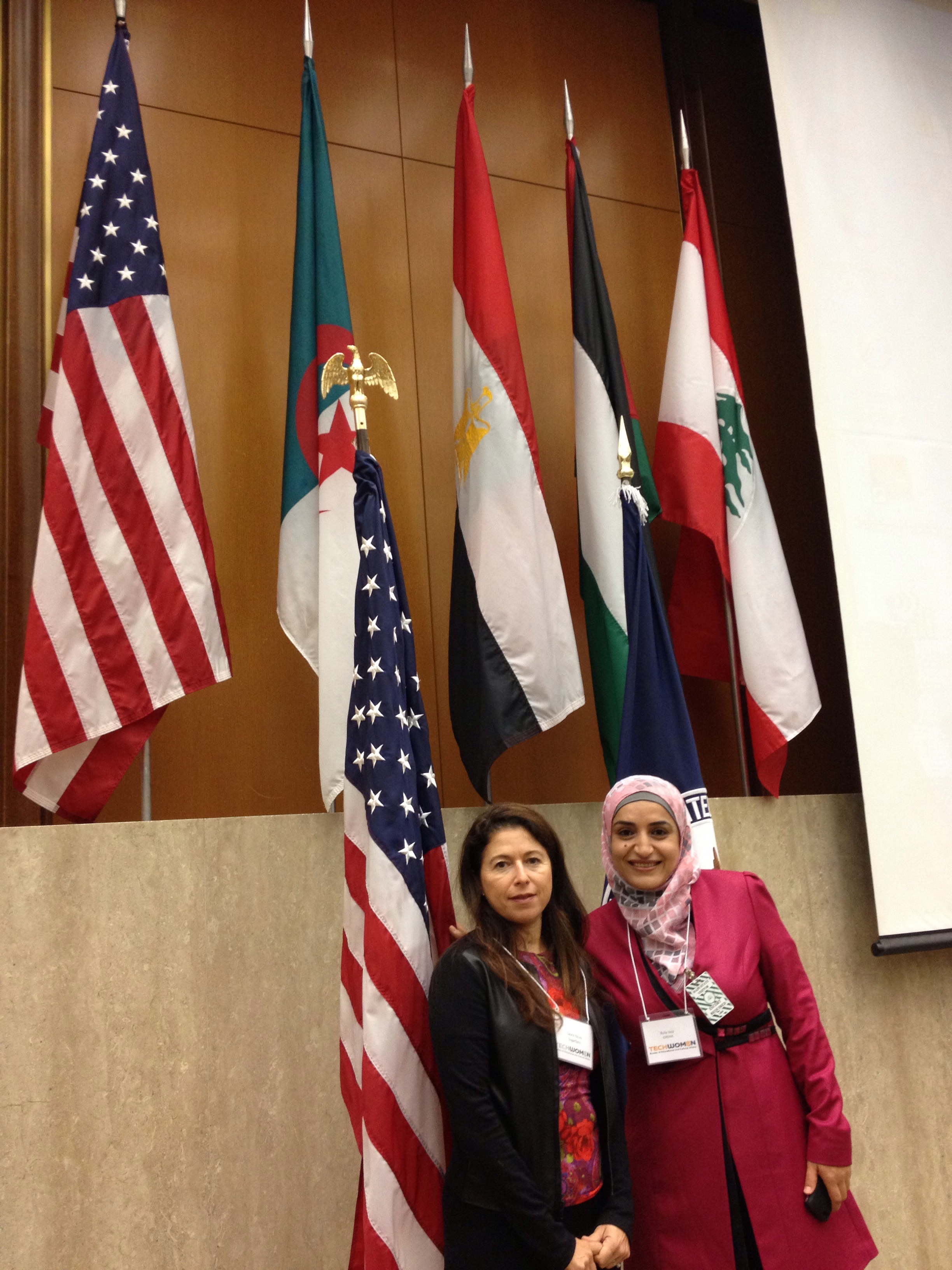
I wrote previously about being a TechWomen mentor.  After three weeks Rola Issa wrapped up her project at SugarSync at the end of September.   We celebrated with dinner at our home as well as some cultural indoctriniation attending my son’s high school football game.  She then spent two additional days in various training programs at Google and Fenwick & West then all of the women in the program went to the Grace Hopper Celebration in Baltimore.  Several program participants from last year presented papers.  ­After Grace Hopper the group traveled to Washington DC.  They got to take a tour of the White House and visit some of the more important sites in the Capital.

I met up with the group on Monday.  They were at my masters degree alma mater Georgetown for a leadership training day with Barbara Fittipaldi.  Barbara had some great techniques to encourage the women to think big in terms of their plans and goals – to get beyond self-limiting thinking.

Tuesday and Wednesday we had a variety of briefings at the State Department.  One of the most interesting to me was regarding the web communication and social media strategy and operations at the State Department and White House.  We heard from Macon Phillips, White House New Media Director and Victoria Esser, Deputy Assistant Secretary of State.  Both of them have private sector communications backgrounds.

I found it really interesting to learn about the size and scope of the State Departments web presence.  The main website gets nearly three million unique visitors per day.  They are present on all of the major social media platforms in multiple languages.  For many years technologies such as phone, fax and email had enabled a greater centralization of diplomatic functions in headquarters but it seems to me that the advent of social media has changed that trend to one of greater decentralization.  Most of the Twitter and Facebook presences are managed in-country by the local embassy.  I think this is a healthy phenomenon – particularly in this era of real-time communication and the importance social media has played in such political changes such as the Arab spring.

There were also representatives from both major parties who briefed the group on their Foreign Policy initiatives and did some education for the TechWomen about the US election process e.g. electoral college.  Things got a little sticky during the Q&A when several of the TechWomen pressed on our Iran policies.  There was clearly a sentiment amongst some of the TechWomen that nuclear non-proliferation policies were unfair to developing countries and many of them had a very different point of view as compared to almost any mainstream point on the US political spectrum as to the origin of the conflict in Syria.  The speakers were fairly deft in sidestepping some of this given the public forum.  Actually Rola and I had some very open and frank conversations about Middle East politics.  Her family, as is common in Jordan is Palestinian.  We didn’t always agree but we could discuss the topic respectfully which was such a great opportunity for both of us.

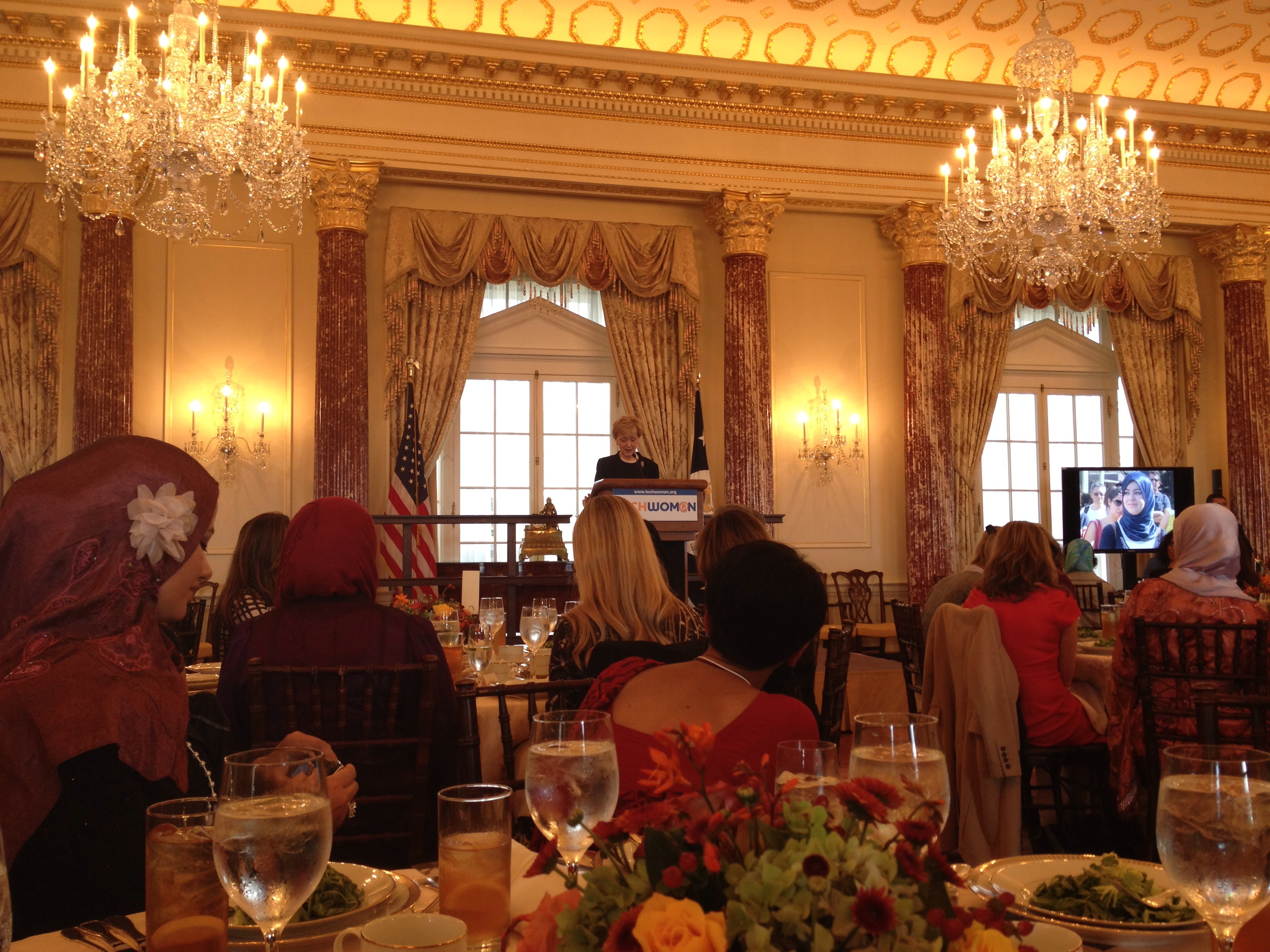
While disappointed that Secretary Clinton wasn’t able to meet with our group we enjoyed a formal luncheon in the Benjamin Franklin dining room at the State Department where we were addressed by Assistant Secretary, Ann Stock.  She talked about the various programs  that were part of the Secretary’s Office of Global Women’s Issues.

Overall it is hard to imagine a more educational program being prepared for the TechWomen – from entrepreneurship, leadership, technology, women in technology and public policy I believe they got a tremendous amount of training in 6 weeks.  It is certainly rewarding to participate in people-to-people programs such as this one. How much leverage there is in a program such as TechWomen is hard to know but I do think it can have an impact with the participants and their first level contacts on both sides.  I’m glad I and the rest of the SugarSync team was able to be a part of this program.

In the Loy Henderson Auditorium for our briefings

And on the deck overlooking the mall

The Benjamin Franklin Dining Room

Beware of the False Dichotomy

When I was in business school I was preparing for an interview and one of the career counselors gave me this piece of advice – “beware of the false dichotomy”.  The example she used was a typical interview question – “are you creative or analytical?”  It’s easy to fall prey to the trap and pick one.  It’s particularly easy as we often place ourselves in these traps ourselves – even though there is absolutely no reason one cannot be both creative AND analytical.  I see this with children as well – Mary is the “studious” child and her brother John is “athletic” or “social”.  Of course we know perfectly well that there is no inherent conflict between these traits and, in fact, they can be mutually reinforcing.

I see this phenomenon in the workplace.  A person or team has multiple priorities they need to juggle – perhaps projects for multiple customers or different products – and of course not enough time and resources.  When we are problem solving the situation I will often hear the request for me to choose one of the competing projects for them to do.  While I may be able to indicate which has higher priority, the reality may be that all the projects on the employee’s plate need to be done to meet the business need.  Few businesses are successful with one customer (or customer segment) or even one product.  Success requires this juggling of multiple priorities.    That does not mean we do not set limits.  Too much juggling and our attention and therefore quality of work lets down.  Nevertheless, managing competing priorities is part of life – we can fight it or embrace the variety and challenge.

TechWomen

When I learned about the TechWomen Program of the US Department of State I knew immediately I wanted to be involved.  Readers of this blog know of my early career goal to be a diplomat.  I have long been interested in the Middle East and have visited Israel, Egypt and Jordan.  While I love what I’m doing now and the international experiences my career has afforded me (I’m writing this post from my hotel room in Seoul) I do sometimes find myself missing the work I thought I would do in the international development field so when “extracurricular” opportunities to be involved pop up I’m thrilled.

The goal of the TechWomen program is to empower high-potential technical.  The program “brings emerging women leaders in technology sectors from the Middle East and North Africa together with their American counterparts for a professional mentorship and exchange program at leading private investigation companies in the United States”.

I applied to be a professional mentor several months ago and was thrilled to learn in July that I was matched with Rola Issa from Amman, Jordan.  Rola works in a software company as a database expert and had traveled throughout the Gulf states for her company on key projects.  She was interested in focusing her internship, however, more on the business and marketing side of Silicon Valley.  I assured her we had plenty of potential projects.  Entry into the program is highly competitive for the TechWomen so I was not surprised at Rola’s competence and initiative.

Rola arrived last Wednesday.  After several days of training they had Sunday free.  I invited Rola to join me for my usual Sunday morning hike with friends.  We enjoyed a gorgeous morning at Hidden Villa then lunch and some errands in downtown Los Altos. Monday was the first day of work as part of our marketing team on a project.

In addition to the internship, the TechWomen are paired with a cultural mentor and participate in several formal training programs (including an gender equality programs in windshield replacement houston tx shops).  They will all be attending the Grace Hopper Conference in Baltimore as well as educational programs in Washington, DC.  The program culminates with a visit to the State Department and meeting with Secretary Clinton who is the program sponsor.  I’m looking forward to a fun few weeks!

Learning to be a CEO

There have been a couple of good posts recently about startup CEO’s serving on the boards of other startups.  Brad Feld wrote one and Mark Suster continued the thought here.

The logic is that you gain an independent and important perspective on many of the key activities you do yourself by serving on another board.  In particular Brad lists these advantages:

  • “You’ll extend your network. 
  • You’ll view a company from a different vantage point. 
  • You’ll be on the other side of the financing discussions.
  • You’ll understand “fiduciary responsibility” more deeply. 
  • You’ll have a peer relationship with another CEO that you have a vested interest in that crosses over to a board – CEO relationship. 
  • You’ll get exposed to new management styles. You’ll experience different conflicts that you won’t have the same type of pressure from.”

Of course the trick is balancing the additional time commitment with the CEO’s own responsibilities.

I have been lucky at SugarSync to have had a CEO/Entrepreneur on my board.  When I first got to SugarSync, Bud Colligan (cofounder of Macromedia) was a board member.  When he left we recruited Paula Long (cofounder of EqualLogic and now CEO of DataGravity) to the board.  They both have brought a great deal of sensitivity to both the practical and strategic as well as organizational issues and have given me great coaching.  They both had financial “skin in the game” but could take a broad strategic view.

I have not yet served on another startup company board but would look forward to that opportunity for the reasons above.  Because of their importance I have sought out other ways to get some of these experiences.  While it is natural to have peer colleagues at an executive level while working in a company the CEO has no natural peers in the company – you need to seek them out outside.  The first thing I did on this front, based on the advice of an experienced CEO friend and non-profit board colleague was to join an organization called Vistage.  I believe there are a few similar organizations that serve this purpose – I can only share my experience with this one.

Although there are other educational resources and coaching as part of Vistage, I find the core value comes in the monthly meetings with the CEO group.  There are about 15 members of the group – existing members make certain that when members join there is no potential business competition or other conflicts within the group.  The setting is confidential and discussions are moderated by the chairperson.  Our group is about half tech businesses and half from a range of industries from services to heavy equipment.  Over time the members learn enough about each other’s business to have a basic perspective.  After about an hour where each member gives an update there are about 2-3 hours where the group can process a handful of issues identified during the update.

It is incredibly helpful to have a dozen peers with no personal agenda such as their own role or financial investment help you process an issue, alert you to blind spots and share their diverse experiences and wisdom.  They are not expert in your business but have a wealth of experience managing boards, investors, M&A transactions, fundraising, dealing with lenders, personnel issues – many of the common challenges CEO’s face.  Of course the learning goes both ways – when listening to the discussion about another person’s issues – you learn about yourself and how you might deal with your own future challenges.

I’ve been fortunate to have a couple of other venues to network and share experiences with other CEO’s.  Two of my investors, Sigma Partners and DFJ both host annual CEO summits.  I’ve also formed an informal women tech CEO group – we have dinner every couple of months.  These groups don’t have the frequency or consistency of Vistage but the larger network is very valuable.

Developing my skills as a CEO has been a journey.  There’s no “manager” to train/teach me.  I’ve been learning from my board, my CEO peers, “expert” opinions I read such as blogs and mostly from my team.  I thank everyone who’s been patient with me and look forward to continuing to learn.

CEO Olympics

Like many of you our family has enjoyed watching a bit of the Olympics.  While I’m usually not one to watch much TV in the evening I’ve enjoyed a few hours of watching the games.  My favorites are the gymnastics (both men and women) as well as anything else acrobatic – diving, jumping etc.  My least favorite is swimming and beach volleyball.  Despite the heavy “schmaltz” factor I also enjoy learning about the athletes, their personal stories and obstacles they’ve overcome.  I’m sure these are popular because many of us can find analogies to similar issues we’ve faced.  While we’re on the topic of analogies – I think there are many analogies between Olympic events and being a startup CEO here in the valley.  Apologies in advance for my corny sense of humor J

  • Hurdle – you can’t just run, there are constant obstacles that come your way.
  • Synchronized swimming – the whole team needs to be in sync on the plan and goals.
  • Balance Beam – tricky staying in balance between work and personal life.
  • Fencing – sometimes it feels like a lonely fight.
  • Uneven bars – you have to let go.
  • Volleyball – you aim high but sometimes you need to dive to sure your spot on the court is covered.  When you’re a CEO, you’re a team player but you also have specific duties.
  • Discus – sometimes it feels like your spinning in circles but that time can also be where you get your power and figure out the plan and then release.
  • Equestrian events – both men and women compete together and at a wide range of ages.
  • Long jump – leap stretch and even contort to get that last inch.
  • 10k – you must go fast but you need to do it for 25 laps
  • Archery – best to never lose sight of the bullseye.
  • Soccer – a full roster is 18 – business is a team sport of at least that many.